Some seasons feel as if the expectations arrive before the team does. The recruiting rankings set the expectations, the goals are obvious, and anything short of winning big feels like failure.
This Indiana team isn’t that.
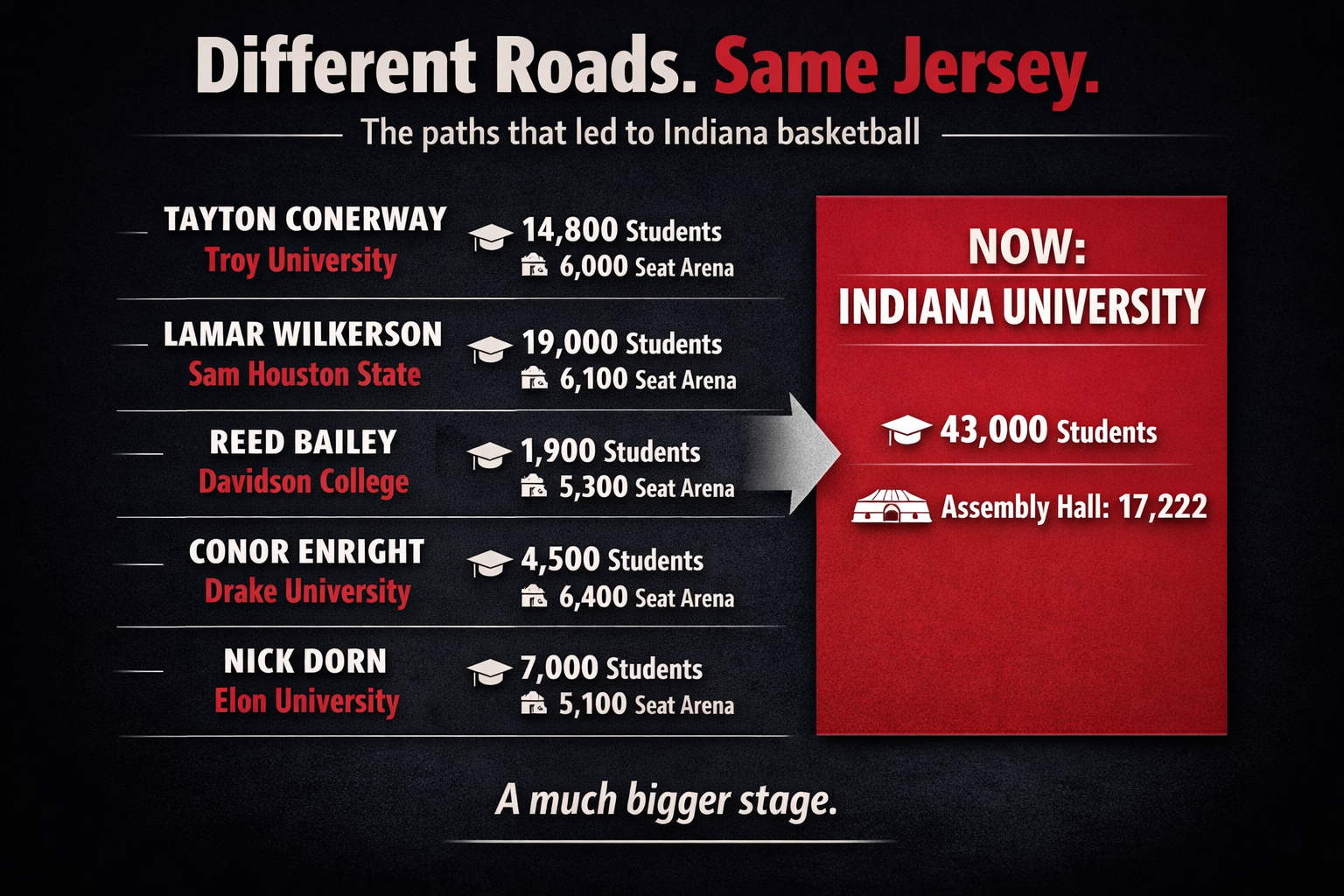
Most of these players had no idea a few years ago they’d be wearing Indiana across their chest, playing under this level of spotlight and expectation. They didn’t grow up on this stage — they stepped onto it. From junior colleges and mid-majors, from smaller gyms and quieter nights, they arrived without guarantees and without shortcuts.
That kind of team doesn’t arrive finished. It arrives becoming.
Learning What the Stage Demands
One of the frustrations with this group has been inconsistency — the inability, at times, to hold the same edge for two full halves. Focus slips. Momentum swings linger. Games tighten when they don’t need to.
That matters.
But it also reflects reality. Most of these players have never lived at this level before — never played where every possession is magnified, where mistakes echo, where expectations weigh as much as the opponent. Managing that pressure is its own skill, and it isn’t automatic.
That doesn’t excuse the lapses — but it helps explain them.
Where the Stage Pushed Back
The bigger stage doesn’t just reveal promise. It exposes limits.
There was the second half at Rupp Arena, where Kentucky Wildcats’s physicality and pace flipped the game and showed how quickly control can disappear in elite environments. And there was the Big Ten road opener at Williams Arena, where a disappointing performance against Minnesota Golden Gophers came in a building that has a way of shrinking visiting teams — especially those still learning what road league games demand.
Neither moment was encouraging.
Both were instructive.
Those games weren’t just about execution. They were about exposure — to noise, physicality, and sustained pressure. The question isn’t whether those nights happened. It’s whether they become scars or reference points.
Signs of Actual Growth
What keeps me engaged with this team is that it hasn’t stood still.
We’ve seen tangible effort to clean things up. They’re working to defend without fouling, something that hurt them earlier in the season. Against Washington — a big, physical team — IU won the rebounding battle, an area that had been a concern. They played with real care of the ball, committing just four turnovers, and the offense showed more discipline, with fewer rushed or extra-long threes and better shot balance.
Those aren’t cosmetic changes.
They’re habits.
And that’s where my evaluation really lives.
What This Tells Us About the Program
As the season unfolds, we’ll learn not just about the players, but about Darian DeVries as well. How does he respond when old issues resurface? How does he demand consistency without stripping confidence? How does a team that’s never lived on this stage learn how to stay there?
For me, improvement matters more than polish. I’m less interested in whether this team looks finished in January than whether it looks better in February than it did in November.
That’s how programs are built.
Why This Season Still Feels Different to Watch
There’s something quietly rewarding about watching a team like this. Not because it will necessarily achieve more than a roster full of stars — it might not — but because every step forward feels earned instead of assumed.
They don’t have a superstar safety net. When something breaks, they have to fix it together. When something goes right, it belongs to everyone. That shared responsibility shows up in unselfish play, unexpected heroes, and resilience when momentum turns.
Those moments don’t always lead to clean wins. But they feel honest.
Maybe that’s the quiet gift of a season like this. It invites patience, rewards attention, and reframes success not as domination, but as belonging — to the work, to each other, to a stage that suddenly feels much larger than anything they’ve known before.
And if something bigger grows from that — if these early lessons become the foundation for something lasting — it won’t come from being crowned early.
It will come from a team learning, night by night, what this stage asks of them — and seeing how they respond.
Leave a Reply